

Quick Answer?
For many New Zealand residential, light commercial, deck, sleepout and retaining wall projects, the best foundation option is the one that reduces delays, limits site disturbance and suits the ground conditions.
Concrete piles are familiar but require excavation, concrete, curing and often pre-pour inspections. Screw piles are faster than concrete but usually require specialist machinery and operators.
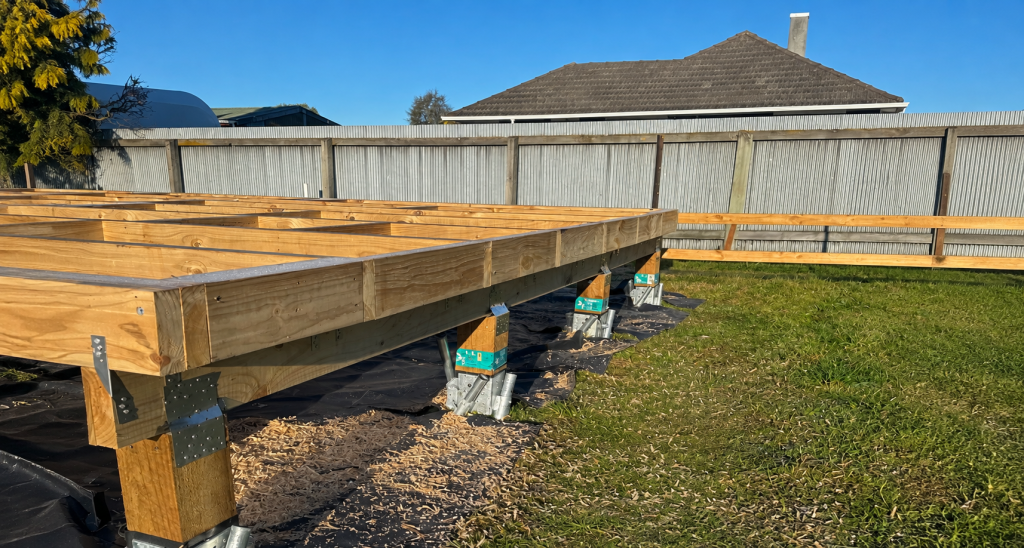
EcoPile is a concrete-free piling system designed for NZ conditions that any builder or competent DIYer can install without heavy machinery and is instantly load-bearing once installed.
Why Foundation Choice Matters
Foundations are one of the first decisions that shape the cost, speed and complexity of a build.
Choose the right system and the project can move quickly. Choose the wrong one and the site can be slowed down by access issues, weather delays, excavation, concrete cure times, inspection scheduling, machinery availability and landscape repair.
In New Zealand, this decision is even more important because sites vary so much. A builder might be working on soft coastal sand one week, steep clay the next, then compacted fill, gravel or rock after that. EcoPile’s existing technical guidance states the system is designed for New Zealand’s variable ground conditions and can be used in conditions ranging from soft coastal sand to steep clay banks, fine gravel and rock, depending on specification and installation method.
Option 1: Concrete Piles
Concrete piles are the traditional choice for many residential builds. Builders understand them, engineers understand them, and councils are familiar with them.
The main drawback is process.
Concrete piles usually involve digging or drilling holes, removing spoil, preparing the hole, arranging inspections where required, pouring concrete and waiting before the next stage of work can continue. On simple flat sites with easy access, that may be manageable. On steep, tight, wet or difficult-access sites, the cost and disruption can quickly increase.
Concrete piles are usually best for:
- Flat sites with easy truck and machinery access
- Projects where concrete is already specified and practical
- Sites where excavation and spoil removal are not a major issue
- Builds where programme speed is less critical
Potential downsides:
- Excavation and spoil removal
- Concrete truck or pump access
- Weather sensitivity
- Cure time before full progress can continue
- Pre-pour inspection requirements where applicable
- Permanent foundations that are difficult to reuse or relocate
Option 2: Screw Piles
Screw piles are a popular alternative to concrete piles. They are mechanically screwed into the ground and can often be installed faster than traditional concrete footings.
For some sites, screw piles are an excellent solution. They reduce the need for wet concrete and can suit projects where excavation is difficult.
However, screw piles typically require specialist machinery, an operator and enough site access for the installation equipment. This can create challenges on tight urban sections, steep sites, landscaped properties, back sections and remote or coastal builds.
Screw piles are usually best for:
- Sites where machinery access is available
- Projects requiring a concrete-free alternative
- Decks, boardwalks, light structures and some residential foundations
- Builds where specialist pile installation is already allowed for
Potential downsides:
- Usually requires specialist machinery
- Site access can limit feasibility
- Installation availability may affect timelines
- Machinery can disturb lawns, gardens and tight work areas
- Hard ground may require alternative methods or additional preparation
Option 3: EcoPile
EcoPile is a concrete-free piling system designed and engineered for New Zealand conditions. Instead of relying on a large concrete mass or a single screw pile, EcoPile uses a multi-directional steel piling system that mirrors the logic of a tree root structure. The system transfers load through a combination of bearing capacity, skin friction and toe resistance.
The major practical difference is that EcoPile does not require concrete, excavation, heavy machinery or concrete curing time. EcoPile’s own installation guidance states that each post can be installed in under five minutes and is instantly load-bearing once seated.
EcoPile is usually best for:
- Residential foundations
- Decks
- Sleepouts and minor dwellings
- Retaining walls
- Light commercial structures
- Sloped or tight-access sites
- Coastal and sandy sites
- Sites where concrete trucks or excavators are impractical
- Projects where speed and low disruption matter
Key advantages:
- No concrete
- No excavation
- No heavy machinery required
- No concrete cure time
- Instant load-bearing
- Suitable for a wide range of NZ ground conditions
- Reusable and recyclable
- Less disruption to lawns, gardens and finished sites
Comparison Table
| Feature | Concrete Piles | Screw Piles | EcoPile |
| Concrete required | Yes | No | No |
| Excavation required | Usually | Minimal | No |
| Heavy machinery required | Often | Usually | No |
| Instant load-bearing | No | Usually | Yes |
| Weather delays | Possible | Lower | Low |
| Suitable for tight access | Limited | Sometimes | Yes |
| DIY or builder-friendly install | Limited | Usually no | Yes, where appropriate |
| Reusable | No | Sometimes | Yes |
| Recyclable | Limited | Often | Yes |
| Best for difficult NZ sites | Sometimes | Sometimes | Often |
So, Which Foundation Option Is Best?
There is no single best foundation for every project.
Concrete piles may still make sense on flat, simple sites where access is easy and the programme allows for curing and inspections.
Screw piles can be a strong option when a concrete-free system is needed and machinery access is straightforward.
EcoPile is often the better fit when the project needs a faster, cleaner, lower-disruption foundation system that can be installed without heavy machinery and used across a wide range of New Zealand site conditions.
When to Ask EcoPile for Advice
Speak to EcoPile if your site has:
- Steep or uneven ground
- Coastal sand
- Clay or variable soils
- Tight access
- A back-section build
- A sleepout, cabin or minor dwelling
- A retaining wall project
- A need to avoid concrete or excavation
EcoPile can help confirm the right system, pile length and installation approach for your project.