

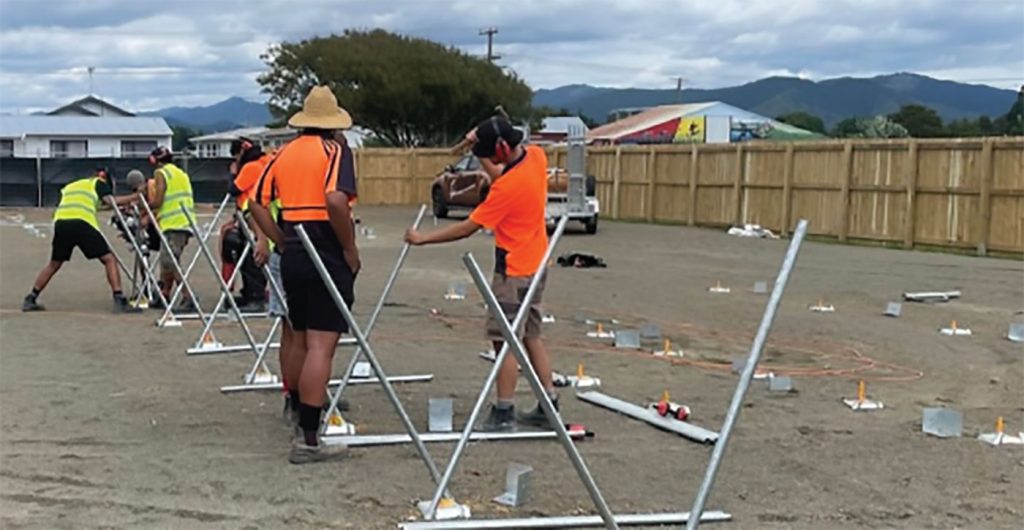
Concrete-free EcoPile foundations offer significant advantages over traditional piling methods, including instant load-bearing capacity, faster installation, reduced labour, and fixed predictable costs. Steel micro-piles are driven directly into the ground without excavation, curing time, or weather dependency, allowing construction to continue on the same day as installation. They also deliver major environmental benefits, with embodied carbon reductions of over 60% compared to concrete, minimal soil disturbance, and fully reusable and recyclable materials at end of life.
Building in New Zealand presents a unique set of challenges, our diverse and often tricky soil conditions often require an innovative approach, especially when it comes to foundations. Traditional construction methods for foundations have long been synonymous with one material – concrete. It is the bedrock of our modern world, strong, durable, and reliable. However, in an era where speed, sustainability, and efficiency are fast becoming the norm, the old ways of digging, mixing, pouring, and waiting are rapidly being surpassed.
The good news is that there is a revolution happening behind the scenes that is quietly transforming the industry – concrete-free pile systems. These engineered footing solutions are not merely convenient alternatives, they offer gains in project speed, cost predictability, and even environmental benefits. Far from being a niche alternative, these precision-engineered foundation solutions are robust, building code-compliant, and highly efficient footings that address many of the frustrations associated with traditional methods.
Let’s explore the benefits of choosing concrete-free piles, focusing on critical process efficiencies, logistical advantages, and significant sustainable building practices that benefit both your project timeline and the planet.
Unrivalled Efficiency
The traditional concrete process is time-consuming. It involves extensive excavation and site preparation, complex formwork, and requires precise logistics for wet materials, not to mention the agonising wait for the concrete to cure that follows. This process can take days or even weeks before any ‘load’ can be safely applied.
Concrete-free piling systems flip these challenges on their head, providing efficiencies that radically accelerate construction timelines and simplify site management.
Reduced Logistical Requirements
Perhaps the most immediate and impactful benefit is the complete removal of the need for concrete trucks, pumps, and mixers. Meaning you don’t have to worry about clearing access for large, heavy trucks, implementing designated washout areas, or potential road closures.
Removing wet concrete from the equation also eliminates the risk of spillage, washout, and contamination of local water sources, which is a significant environmental and compliance issue on traditional construction sites.
Increased Installation Speeds
The speed and simplicity of installing concrete-free piles represent the largest efficiency leap. Systems like micro-pile foundations or various helical pile systems are installed using compact, specialised machinery, often small hydraulic drive heads mounted on mini-excavators or even heavy-duty jackhammers. The time savings are quite dramatic:
- Installation Time: A single concrete-free pile can be installed and load-ready in as little as 10 to 45 minutes, depending on the system and soil conditions. Compare this to the hours of digging, form setting, and pouring required for a single traditional footing.
- Reduced Labour: Installation typically requires a minimal crew, often just an operator and a spotter, significantly reducing overall labour costs and site management overhead.
- Fixed Costs And Certainty: The installation process is entirely mechanical. Once the site-specific engineering design is complete, the footing system cost and installation time become highly predictable, replacing the variable costs associated with concrete volume, mixing conditions, and labour overruns.
Instantaneous Load Bearing
One of the biggest drawbacks to concrete foundations is the required curing time. Builders must often wait days or even weeks for the concrete to reach sufficient compressive strength before they can proceed to the next stage of the build. This enforced downtime introduces delays and makes projects susceptible to weather-related issues.
Concrete-free steel piles, however, are instantaneously load-bearing. The moment the pile is driven or screwed to the required torque and depth (verified by engineering specification), the foundation is ready to accept the structure above it. This means teams can seamlessly move from foundation installation to frame erection on the very same day. Plus since there are no wet materials, installation is largely unaffected by rain, frost, or extreme heat, avoiding costly weather delays.
Rapid Installation
The primary benefit of engineered steel piles is the speed of installation. Using a small excavator or specialised small machinery, piles are able to be mechanically screwed or driven directly into the ground.
This process is surgical and swift, resulting in very little ground disturbance. A single crew can install numerous piles in a day, regardless of whether they are working on a simple deck or a complex commercial structure. And the biggest benefit – there is zero curing time, zero waiting, and zero weather dependency beyond extreme high winds.
Reduced Embodied Carbon
The primary environmental benefit of concrete-free piles is the immense reduction in embodied carbon. Embodied carbon refers to the greenhouse gas emissions associated with the materials and construction process, from raw material extraction to transport and manufacture.
The construction industry is under increasing pressure to decarbonise, and for good reason. Cement production accounts for approximately 8% of global CO2 emissions. Steel piles, typically made from high-strength, often recycled, steel and requiring only minimal heavy machinery for installation, can achieve an embodied carbon reduction in excess of 60% compared to traditional concrete foundations.
Minimal Site Disturbance And Soil Preservation
Traditional foundations require significant excavation, which results in several negative outcomes including large amounts of excavated soil that must be removed from the site and often end up in landfills, and ongoing effects on soil integrity. Mass excavation disrupts the natural stratification and composition of the soil, potentially impacting local ecosystems and natural drainage patterns.
Concrete-free systems offer a “no-dig” or “minimal-dig” solution, as piles are screwed or driven directly into the ground, displacing minimal soil and preserving the site’s natural grade and landscape.
Reusability And Recyclability
Although concrete is highly durable, it is fundamentally non-reusable and difficult to recycle in a closed-loop system. At the end of a structure’s life, a concrete foundation must be mechanically broken up and hauled away as debris.
Steel pile foundations however, are fully reversible. Helical or micro-piles can be unscrewed or extracted with minimal effort, leaving the site virtually undisturbed. The piles can then be refurbished and reused for a new project if needed, extending their functional lifespan. And when they reach the end of their operational life, the high-grade steel is recyclable, returning valuable raw material to the manufacturing stream without creating landfill waste.
Diverse Load Capacity
The engineering principles behind modern engineered pile systems are very robust. While concrete relies purely on compression and the bulk of the material, steel micro-piles leverage a combination of skin friction and bearing capacity, much like a tree root system. This design provides exceptional load resistance in multiple directions and because the piles are installed to a verified torque or depth, the immediate load capacity is known and certified by engineers the moment installation is complete.
Adaptability To Difficult Sites
Concrete-free foundations shine where traditional foundations fail or become prohibitively expensive. This includes:
- Sloping Sites. Where they can be installed on steep or uneven terrain without the massive excavation and retaining walls required to level the ground for a conventional slab or trench footing.
- Difficult Soils. They perform exceptionally well in variable, soft, or unstable soil conditions by anchoring the structure into deeper, more stable layers of soil or rock.
- Remote Or Hard To Reach Locations: The reliance on small, portable equipment means concrete free foundations are the perfect solution for remote, difficult-to-access sites, like island resorts, national parks, or back-of-house commercial areas where maneuvering a massive concrete truck is impossible.
For New Zealand builders, developers, and homeowners looking to build faster, cleaner, and smarter, exploring the benefits of engineered concrete-free footings is no longer just an alternative, it is the future of foundations. Ready to revolutionise your next project? Learn more about concrete-free foundations from the team at EcoPile.